Upgrading Your Brakes for Production Car Racing
Date Posted:28 April 2026
Upgrading Your Brakes for Production Car Racing: What Really Makes a Difference
If you’ve been involved in production car racing lately, you’ve probably noticed something changing—and it’s not just lap times.
There’s been a clear shift in regulations, opening up more freedom around brake upgrades. For teams, workshops, and drivers, this presents a real opportunity: you’re no longer limited to “just enough” braking—you can now build a system designed for performance, consistency, and endurance.
At MSB, we’ve been supplying braking solutions into production car racing for many years, and one of the most common questions we’re getting right now is:
“What should I actually be upgrading?”
The New Era of Brake Upgrades in Production Racing
With increased flexibility in regulations in some categories, teams are now able to upgrade key components of their braking system, including:
- Rotor size and mounting systems
- Brake pad volume and compound
- Caliper size and piston configuration
- Brake cooling systems
While all of these play a role, one of the most overlooked—and misunderstood—areas is brake pad size and volume.
Why Brake Pad Volume Matters More Than You Think
When most people think about brake upgrades, they jump straight to bigger calipers with more pistons, or larger rotors. But the brake pad itself is a critical part of the system’s overall capacity.
More pad volume means:
- Increased heat capacity
- Improved consistency over long stints
- Reduced wear rates
- Better performance under endurance conditions
This becomes especially important in endurance racing, where managing heat and maintaining performance over time is everything.
Comparing Common Brake Pad Setups
Let’s look at a few real-world examples to understand how brake systems scale.
1. OEM-Level Performance: Factory 2 or 4-Piston Systems
A typical starting point would be a factory four-piston setup, like those found in the BMW F80 M3, or equivalent models such as the M2 and M4. This is a car that has been very successful in Australian Production Car Racing, including the endurance events such as the Bathurst 6hr.
These systems are well-engineered for road and light track use, but in a racing environment, they can quickly reach their limits—particularly in longer sessions.
This is why these vehicles have been upgraded to aftermarket brake systems designed to deal with the energy levels required.
2. Entry-Level Motorsport Upgrades: Such as AP Racing 4-Piston
A common upgrade path is moving to a motorsport-focused four-piston setup, such as those from AP Racing, Alcon, Brembo and others.
These typically use a pad around 17mm thick, and you’ll often see this configuration in cars like the Toyota 86 or Subaru BRZ running in non-outright classes.
For many applications, this setup offers a solid balance of Performance, Cost and Reliability and for lighter cars - presuming good quality components are being used - this is more than sufficient.
3. Stepping Up: 6-Piston Brake Systems
As performance demands increase in some of the heavier, faster cars, many teams move into six-piston caliper setups for the front brakes from racing brake brands.
This is where a lot of confusion happens and sometimes cars can be fitted with under-specified brake systems that are not up to task.
Misunderstood Upgrade: Pad Thickness
A common conversation we have goes like this:
“I’ve got the big AP six-pot kit.”
In most cases, what they’re referring to is a standard 6 piston AP Racing caliper, but with 18mm thick racing pad.
What many don’t realise is that same pad shape is also available in a 25mm thick version.
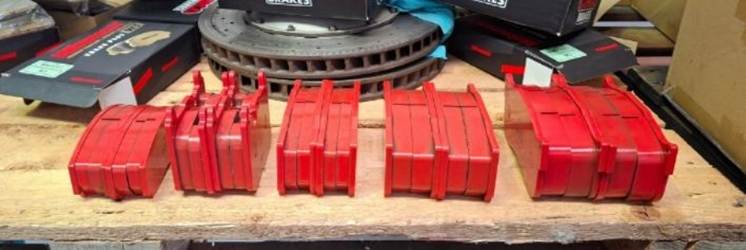
That increase in thickness might not sound like much—but in braking terms, it’s significant.
Keep in mind we measure the total thickness of the pads, not just material. Most racing pads have a 5-6mm thick steel backing plate, so going from 18 to 25mm gives an extra 7mm per pad. That’s an overall gain of 28mm of pad material. Often for the same cost too!
What an Extra 7mm Really Gives You
Keep in mind we measure the total thickness of the pads, not just material. Most racing pads have a 5-6mm thick steel backing plate, so going from 18 to 25mm gives an extra 7mm per pad. That’s an overall gain of 28mm of pad material. Often for the same cost too!
It can also offer:
- Substantially more thermal capacity
- Longer service intervals
- Greater consistency across a race stint
- Improved resistance to fade
And importantly:
You can often achieve this without changing the overall fitment footprint of the system—just the caliper configuration.
This is why pad volume is such a powerful lever in brake system design.
Why This Matters for Endurance Racing
In sprint racing, you might get away with a marginal setup.
In endurance racing, you won’t.
Heat management becomes the limiting factor, and the teams that get it right are the ones who:
- Maintain consistent lap times
- Reduce pit stops
- Protect other components in the system
A larger, higher-capacity brake package—especially one with increased pad volume—can be the difference between finishing strong and struggling with fade halfway through a stint.
It’s Not Just Bigger—It’s Smarter
Upgrading your brakes isn’t just about going bigger across the board.
It’s about:
- Matching the system to your car and class
- Understanding how each component contributes to performance
- Maximising efficiency within the rules
And often, the biggest gains come from details that are easy to overlook—like pad thickness and volume.
Need Help Choosing the Right Setup?
Every car, class, and driver requirement is different.
Whether you’re running a near-standard production setup or building a full endurance package, getting the brake system right is critical—not just for performance, but for reliability and safety.
At MSB, we work with:
- Race teams
- Performance workshops
- Enthusiasts stepping into motorsport
If you’re unsure what your best option is, or you want to make sure you’re getting the most out of your current setup, we’re always happy to help point you in the right direction.
Talk to the team at MSB about your next brake upgrade.